How to Sell Valves and Steam Products Into a Refinery's Changing Buying Center
A connected, evidence-based guide to finding the process, reliability, maintenance and procurement roles that determine refinery valve and steam equipment purchases.
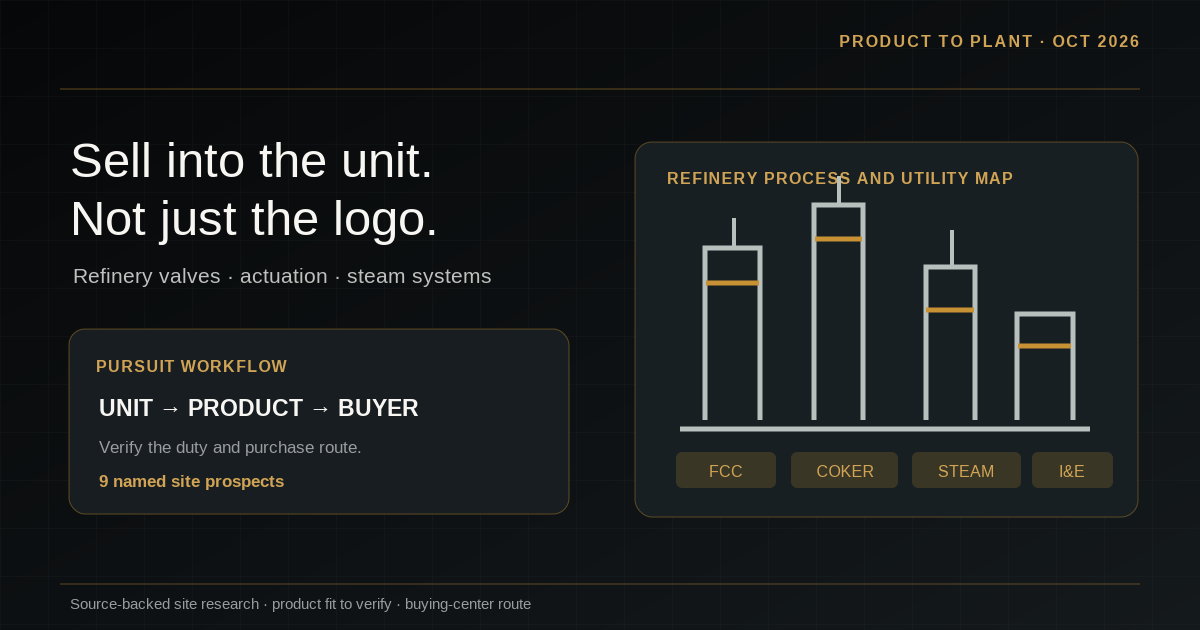

A refinery equipment opportunity rarely begins with a purchase order. It begins with somebody who understands a troublesome valve, a steam loss, or an operating limitation well enough to challenge how it is being maintained. The seller's task is to find that problem, establish whether the product can solve it safely, and understand who will accept the technical and commercial risk. Knowing the refinery's name is only the first step.
This distinction is especially important when the people inside the buying center are changing. In ExecGraph's October 23, 2026 Energy snapshot, the database includes 1,808 current contacts with process-engineer titles, 455 reliability engineers and 264 maintenance managers. After screening the movement ledger from April 3 onward for pending and review-flagged events, we identified movement signals affecting 137, 33 and 31 distinct people in those respective current-title cohorts. These are not counts of refinery vacancies; they measure observable changes among contacts who currently hold these kinds of roles somewhere in ExecGraph's Energy coverage.
For a supplier of process valves, automation, steam equipment or instrumentation, that suggests a more disciplined way to manage a territory. Begin with a technical reason to be at the plant. Build a buying center around the actual decision. Then maintain that map as the people change, rather than waiting for a stalled RFQ to reveal that the old relationship has moved.
Begin with the operating problem, not a list of refineries
Consider a valve company approaching a refinery because an FCC or delayed-coking system may use its products. The presence of a process unit establishes a possible application, not a business opportunity. A useful sales discussion needs the process duty, installed valve tag or specification, failure mode, inspection history and timing. An FCC can create a very different question from a refinery steam header, even when both use control valves and actuators. The engineer who determines acceptable trim or materials may differ from the person responsible for the outage work package.
For that reason, public information is best used to select the first conversation, not to predict a purchase. Phillips 66 Lake Charles publishes a site description that names FCC, alkylation, delayed coking, hydrocracking and reforming operations. A valve seller can therefore prepare a short set of questions about the relevant unit before asking for a meeting. The first question is not “Who buys valves at Phillips 66?” It is “Who supports reliability and process engineering for this duty, and what operating evidence would justify looking at an alternative?” Official plant context.
Where there is a dated event, the approach changes again. PBF's 2026 guidance described a Gulf Coast crude-unit/coker turnaround planned for the fourth quarter. That is an appropriate reason to investigate whether Chalmette Refining still has relevant inspection, repair, or valve-automation scope. It is not proof the tender remains open in late October. A qualified vendor first confirms who holds the package, whether engineering has already frozen specifications, and whether execution runs through the operator, an established contractor or a current MSA. PBF's published guidance.
A steam and condensate supplier has a different opening. Marathon Galveston Bay describes cogeneration capability and production of up to 4.3 million pounds of steam per hour. That creates a credible reason to ask a utilities engineer about distribution, condensate recovery and trap inspection; it does not establish how many traps are installed or whether a survey is budgeted. Compared with sending a generic refinery capability brochure, a proposal to document one bounded utility-system problem is an easier technical conversation to evaluate. Marathon's facility information.
Follow the product through the technical buying center
Equipment sellers often overestimate the importance of a single buyer title. In an operating refinery, the process engineer may determine whether a new product meets the application's duty, reliability engineering may own evidence about repeated failures, and the maintenance manager may decide whether the repair can fit into the work schedule. Procurement still matters, but it cannot approve the engineering and operational assumptions for all three groups.
| Decision in a valve or steam pursuit | Typical function to investigate | Evidence the seller should bring |
|---|---|---|
| Is the product technically acceptable? | Process engineering, mechanical engineering or I&E | Operating conditions, applicable codes, material/valve specifications and a documented comparison |
| Is this problem worth changing the equipment or repair method? | Reliability engineering and asset integrity | Failure history, inspection findings, repeat work, maintainability and measurable performance |
| Can work be executed safely in the required window? | Maintenance management and turnaround planning | Work boundaries, safe access, labor capability, parts lead time and outage requirements |
| How can the vendor legally transact? | Site or corporate sourcing; approved contractor or distributor | Supplier eligibility, MSA/PO route, insurance, HSE documentation and OEM limitations |
The sequence is not universal. A site may centralize engineering or purchasing, or require OEM signoff. But treating all these functions as one “decision maker” usually conceals the very reason a technical sale stalls. It is safer to show an unresolved role on an account map than to assign plant authority to a person whose title only proves corporate employment.
Career movement changes the selling route, not just the CRM record
The same research that maintains a contact directory can signal when this chain of influence needs attention. Among the current Energy process-engineer cohort, 84 distinct people have screened title-change signals and 29 have screened employer-change signals from April 3 through October 23. Reliability engineers show 18 title-change and 12 employer-change signals. Maintenance managers show 19 and six. People may have more than one signal type, and these are retrospective observations of current-title cohorts, not confirmed replacements at a particular refinery.
That matters during a product evaluation. If an engineer who supported a pilot changes role, the vendor should not assume the project is dead. The technical reasoning, original specification and test history should remain documented, and the account owner should identify who now signs off on the application. If the maintenance manager changes, the next conversation may need to reestablish the scheduled work, field-service requirements and who controls the contractor. A relationship may survive, but the buying authority cannot simply be inherited.
Retirement calls for the same discipline. ExecGraph currently marks 203 Energy contacts retired, while 70 distinct Energy people have a narrower provider event explicitly flagged retirement-confirmed. Those are platform-wide cohorts, not refinery-specific figures. A retired technical leader may retain useful history or provide an introduction, but a seller must separately corroborate the successor who now owns the work. Our broader March to October people-movement analysis explains the difference between retirements, new-hire flags and verified career events.
Turn the intelligence into a pursuit that can advance
For a valve supplier, a productive account review might start at Phillips 66 Lake Charles: choose an identified process unit, identify one valve duty, then ask which technical function owns the relevant specification and which reliability evidence supports a repair or alternative. At Chalmette, the same vendor would first verify whether turnaround scope is already committed before spending time on a late bid. At Marathon Galveston Bay, a steam vendor would begin with the utilities team and a bounded survey or loss-assessment question rather than infer a trap count from steam capacity. Each lead has a different first step because the commercial trigger is different.
After that initial discovery, the team should build a living buying-center record: the specific plant and unit, technical sponsor, reliability owner, work planner, purchasing route, current evidence date and unresolved questions. Only when the customer confirms a need, a credible time window and an available route to transact should the opportunity be presented as qualified pipeline. That is the point where industrial intelligence becomes useful to someone carrying a sales number.
Scope and research method
Facility examples are grounded in the linked public operator/investor pages and represent technical prospecting opportunities, not confirmed open RFQs, installed OEMs, current purchase orders or direct supplier qualification. The role statistics are first-party ExecGraph aggregates queried October 23, 2026. They use current Energy contact titles for three defined role families and deduplicated movement signals observed from April 3 through October 23, excluding records explicitly marked pending or requiring review. Neither a current title nor an observed job change proves assignment to a named refinery or budget authority. Private contact identities and customer pursuits are not published.
Related analysis: How reliability and maintenance decisions change at power stations and How process engineers influence LNG and chemical equipment decisions. For the broader evidence policy see ExecGraph methodology.
Evidence and interpretation
The figures in this article are aggregated observations from ExecGraph's Energy coverage, not estimates of the whole industry or confirmed plant-level purchasing authority. Definitions, measurement periods and public facility sources are explained in the article itself.
Read the research methodologyQuestions Answered
What role does a process engineer have in a refinery valve purchase?
Process engineering may determine operating duty and technical acceptance, but role authority must be verified per facility and product application.
How do reliability and maintenance teams differ in equipment procurement?
Reliability evaluates equipment failure and repair outcomes, while maintenance management controls execution access and the work schedule. Actual responsibilities vary by plant.
How much movement has ExecGraph seen in these roles?
Among current Energy title cohorts, screened movement signals touched 137 process engineers, 33 reliability engineers and 31 maintenance managers from April 3 through October 23, 2026. These are not refinery-specific vacancy counts.
Does a published refinery turnaround guarantee an open RFQ?
No. Confirm work package ownership, qualification status and current bid access with the facility or authorized contractor.
Build the buying center for your next plant opportunity
Explore the current technical, operating and purchasing roles at your target facilities. Record-level source, date and confidence vary by pursuit.
Request accessAccess requests are reviewed before an account is activated.
Explore the Energy contact coverage behind the research
The November 1 coverage report maps 73,839 contact records across 1,086 linked company records, with graphs by function and company breadth.
Read Energy Contact Coverage: November 2026 →