Selling Valves and Instruments to LNG and Chemical Plants Through Process Engineering
How process engineering, reliability and procurement decisions shape LNG and chemical plant equipment sales, backed by ExecGraph's 2026 engineer movement research.
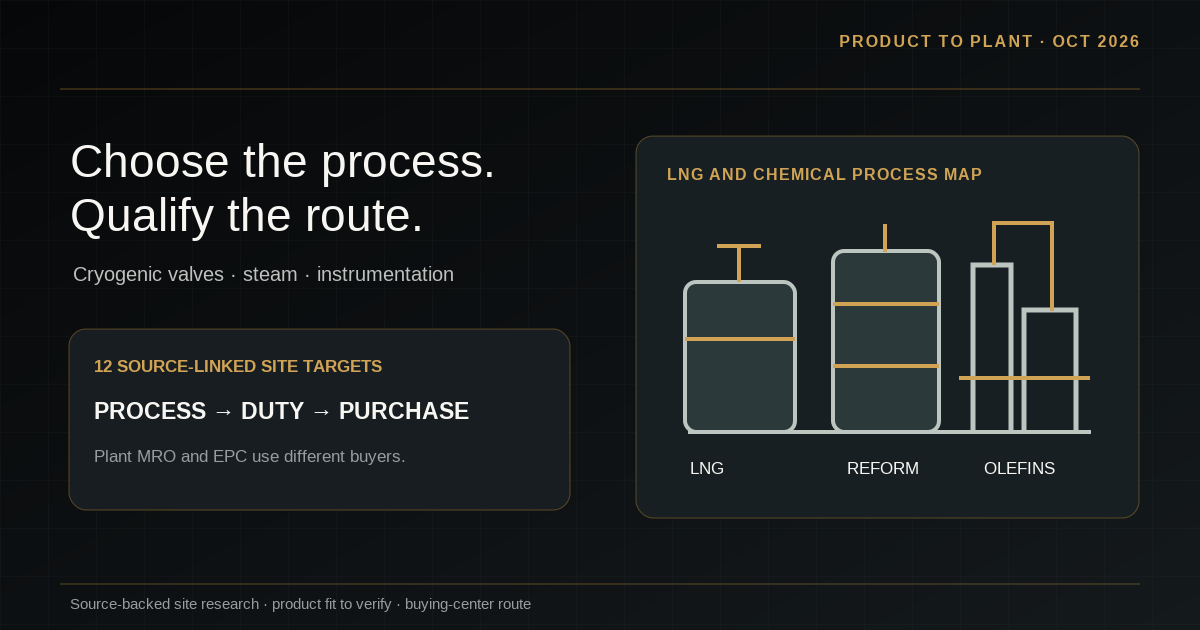

The first technical discussion about an LNG or chemical-plant valve is rarely about its catalog number. It begins with process conditions: the fluid, temperature, pressure, materials, operating cycle, emission requirements and the consequences if the equipment cannot perform. A seller who has not understood those constraints cannot confidently approach the person who may need to approve a product substitution.
This is why process engineers deserve a much stronger place in industrial sales research than another generic list of procurement contacts. ExecGraph's current Energy records include 1,808 contacts matching its process-engineer title family. Of those, 137 distinct people have at least one screened career-movement signal observed from April 3 through October 23, 2026. We also see 455 reliability-engineer title matches and 264 maintenance-manager matches, but the three groups do not automatically share responsibility at every facility. These are Energy-wide research cohorts, not a claim that the named LNG and chemical plants employ those exact people.
A relationship change matters because a well-supported engineering preference can be carried by a person, whereas the plant's technical requirements and approved supplier process must survive that person's departure. The vendor needs to understand both before it can turn an introduction into a product opportunity.
At Sabine Pass, distinguish the engineer who specifies from the organization that buys
Cheniere has publicly described its Sabine Pass LNG expansion work, including a May 2026 engineering, procurement and construction agreement with Bechtel and early procurement authorization. That is a real project signal for qualified suppliers to research. It is not evidence that a particular cryogenic valve or instrumentation package remains open today. Cheniere's project information.
Consider a manufacturer of high-integrity isolation valves. For a new LNG train, the technical inquiry begins with the process data sheet and accepted design standards. An EPC engineer may own the project specification, the EPC buyer may manage the purchase package, and the owner may retain specified standards or project approval rights. On an existing operating train, the conversation could instead concern asset reliability, inspection, repair access and approved spares. Those are different routes even though the valves might look similar in a catalog.
Cheniere also publishes supplier and contractor resources and requires suppliers to be vetted. Registration is necessary for some routes but is not a substitute for an engineering sponsor, a released purchasing package, or verified vendor approval. A serious first call should ask where the application sits in the EPC/owner responsibility split and whether the product is still in a specifiable phase.
Process engineers bridge operating requirements and commercial opportunity
The same principle is visible outside LNG. Methanex Geismar publicly describes multiple methanol plants and steam-reforming operations, providing a credible starting point for a steam-system or process-instrumentation discussion. A steam products distributor should not infer a trap population from the number of plants. It should learn how the particular utility system is arranged, what losses or maintenance concerns have been documented, and which operating or process engineer can accept a survey. Methanex's plant description.
INEOS Chocolate Bayou offers another distinction. Its public site materials describe cracking and downstream polymer-related operations, which create different fluid services and technical requirements. An actuator or control-valve supplier should ask for the relevant unit duty and engineering acceptance route, not treat a cracker, polymer production and site utilities as one homogenous equipment category. INEOS site information.
These examples help explain why a technically useful territory plan is organized around the process and the problem, not just by company. The engineering conversation can tell a salesperson whether a product family has a legitimate application before time is spent chasing the wrong sourcing group.
| Industrial product context | Technical question that comes first | Function to validate next |
|---|---|---|
| LNG process isolation or control | What cryogenic and process duty, pressure class, material compatibility and accepted test standards apply? | Process/mechanical engineering, EPC package engineer or operating LNG reliability |
| Methanol reforming and plant utilities | What steam/condensate balance, operating pressure and documented failure or loss warrants intervention? | Utilities/process engineer, plant reliability and maintenance planner |
| Olefin or polymer production | Which named unit and application determines material, control performance and hazardous-area requirements? | Unit process/I&E engineering and technical asset owner |
| Repeat instrument or valve repair | What inspection history supports repair or an approved alternative instead of replacing in kind? | Reliability engineer, instrumentation lead, maintenance owner and sourcing |
The platform shows meaningful movement among process engineers
Among the 1,808 current Energy process-engineer title matches, 137 distinct people have screened movement signals across the recorded April to October window. Within that cohort, 84 people have title-change signals, 29 have employer-change signals, and 21 have promotion signals. These types can overlap for one contact; their totals are not a count of separate employees. Because the cohort is defined by the person's current title, the observation cannot be used to calculate how many process-engineer vacancies opened or were filled at a particular plant.
The implications for a manufacturer are nevertheless practical. An engineer who moves into a higher role may broaden the range of equipment he or she influences, or may lose responsibility for an earlier application. An engineer who changes employer can change the vendor's entry point at both the prior and new accounts. The right next step is to establish the person's current scope and separately identify who now owns the former unit specification. Otherwise the seller risks presenting yesterday's approved solution to a new decision-maker who has never evaluated it.
Reliability and maintenance movement reinforces that requirement. Among the current Energy cohorts, 33 reliability engineers and 31 maintenance managers have screened changes. If the instrument engineer remains but the maintenance work-package owner changes, the route to execute a repair may still need to be rebuilt. Maintaining relationships means maintaining the roles and evidence around the decision, not just updating the individual's employer field.
New hires are not the same thing as new industry entrants
This is one area where it would be easy to publish a large but misleading number. ExecGraph has 4,092 Energy contact rows flagged as new hires, but all of those records were first ingested into the platform in March. The flag does not establish a new employment event during the full March to October period, and a senior process engineer changing companies is not a first-time entrant to the energy industry.
Among Energy contacts with recorded career histories, only 37 currently have an earliest dated recorded career-position start in 2026. Even that number is not verified first-time industry entry because career histories can be incomplete or undated. ExecGraph separately records 7 distinct Energy people with industry-return events in September and October. They represent people returning to the sector, not inexperienced graduates joining it. The full people-movement article explains exactly what the data can and cannot support.
For a salesperson, the useful research task is to ask whether a new technical contact has prior plant experience, what process responsibility has changed, and who mentors or approves the new role's engineering decisions. That is considerably more valuable than assuming every new hire needs an introductory product presentation.
How to move from engineering relevance to a purchase
A successful industrial equipment pursuit can be understood as a sequence. First, establish a real process or maintenance duty from a credible source. Second, validate the engineer or reliability group responsible for that requirement and the drawings or nonconfidential specifications needed to test the application. Third, identify the maintenance window or project package, since a new LNG expansion and an operating methanol plant do not purchase in the same way. Finally, confirm the approved vendor and contracting path through the owner, EPC, OEM or distributor.
For an actuator manufacturer this might mean an engineering acceptance discussion about torque, fail position and control duty. For a steam-systems vendor it could be a bounded utility survey with appropriate site safety controls. For an instrument supplier the first step may be establishing materials, certification and calibration requirements. In every case a named plant and a public project signal improve preparation, but neither confirms that the facility is accepting new bids.
Methods, dates and publication boundary
The role figures are aggregate first-party ExecGraph observations queried October 23, 2026. Current-title matching identifies process, reliability and maintenance role families within the Energy population, excluding obvious nonindustrial software/site reliability titles. Movements are distinct people with at least one relevant signal between April 3 and October 23, excluding rows explicitly tagged pending confirmation or review. Counts are neither the entire labor market nor verified assignment to Cheniere, Methanex, INEOS or any other named plant. No protected personal data, private customer pursuits or inferred buyer authority is disclosed.
Public site/project descriptions are operator-provided and must be checked for current scope. To apply this approach in other markets see refinery technical buying centers and power plant maintenance and reliability purchasing, or the ExecGraph research methodology.
Evidence and interpretation
The figures in this article are aggregated observations from ExecGraph's Energy coverage, not estimates of the whole industry or confirmed plant-level purchasing authority. Definitions, measurement periods and public facility sources are explained in the article itself.
Read the research methodologyQuestions Answered
Why do process engineers matter for industrial valve and instrumentation sales?
They may establish process duty and technical acceptance, including materials, control performance and applicable standards; specific authority must be corroborated at each site.
How many process engineers does ExecGraph's current Energy dataset include?
1,808 title-matched Energy contacts as of October 23, 2026. A total of 137 had screened career-movement signals since April 3; neither count establishes plant-specific buyer authority.
Is Cheniere's Sabine Pass EPC work an open request for valve quotes?
No. The public EPC and early-procurement milestones justify researching package availability and supplier qualification, not claiming an open order.
How many verified first-time industry entrants were identified since March?
A reliable first-time-entry count has not been established. March new-hire flags are import-time labels and the recorded career histories are not complete enough to certify first energy jobs.
Build the buying center for your next plant opportunity
Explore the current technical, operating and purchasing roles at your target facilities. Record-level source, date and confidence vary by pursuit.
Request accessAccess requests are reviewed before an account is activated.
Explore the Energy contact coverage behind the research
The November 1 coverage report maps 73,839 contact records across 1,086 linked company records, with graphs by function and company breadth.
Read Energy Contact Coverage: November 2026 →