Human Capital Research
Engineer Tenure Changes the Sales Conversation.
A process engineer works out how a plant's production steps work together to make the required product safely and consistently. For a seller, career context matters because someone learning a role may need different technical support than someone who has already worked through similar plant problems. Tenure is useful context, not proof of individual purchasing or technical authority.
The evidence behind the article
Documented tenure distribution
Time in the current role and time with the employer are separate measures. The median and middle half describe the usable histories, not an individual's authority.
Updated tenure measurements are being revalidated. The distribution chart is not currently available. It appears here only when the current measurements pass validation and match a human-approved evidence record. Earlier values and illustrative percentages are not substituted.
The seller's question
Are you helping someone understand the plant, evaluate an improvement, or build a credible case for change?
First, understand what the engineer does
A supplier needs to understand two things before approaching an engineer: the work that person performs and the experience they bring to it. A title helps identify the first. Career history provides context for the second.
Process engineer: how the production system works
A process engineer works out how the steps in a plant should work together to make the right product safely, consistently, and with less waste.
They follow material through the plant: where it enters, how it is heated or cooled, where it is mixed or separated, and what leaves as finished product. They examine temperatures, pressures, flow rates, and product quality to understand whether the system is performing as intended. Their work can include designing new systems, improving existing ones, and investigating operating problems.[1]
A plant might run all its equipment but still produce less than expected. Is a cooler unable to remove enough heat? Is a separation step failing to produce the required purity? Would increasing production in one area overload another?
The process question: What does the production system need to do differently?
Chemical engineer: what happens to the material
A chemical engineer uses chemistry, physics, and mathematics to understand how materials can be transformed, separated, and handled at industrial scale.
That includes reactions, but also operations that do not change a substance's chemistry: heating, cooling, filtering, and separating mixtures. Material and energy balances account for where substances and energy go. They help explain how changing one condition affects the result.[2]
For example, raising a temperature might change reaction speed, unwanted byproducts, or product quality. The question is not simply whether the heater can get hotter. It is whether the material will behave as required.
The chemical question: What happens to the material when we change the conditions?
Mechanical engineer: how the equipment performs
A mechanical engineer designs and evaluates the physical equipment that moves, contains, heats, cools, or supports the process.
The work draws on forces, materials, motion, heat transfer, and fluid flow. At a plant, that expertise may apply to pumps, piping, vessels, and heat exchangers. It is broader than repairing machines: it includes understanding whether equipment can meet the required conditions and how it may fail.[3]
A proposal to increase production may require a pump to operate differently. A mechanical review could examine equipment suitability, stresses or vibration, and the effect on maintenance requirements.
The mechanical question: Can the equipment do the job reliably under these conditions?
Chemical and mechanical engineering are disciplines; process engineer is a job. A chemical engineer may work as a process engineer. These are overlapping perspectives, not three assumed contacts or three separate purchasing authorities.[1]
One operating problem can involve all three perspectives
Consider a hypothetical plant that has slowed production because product leaves a cooler too hot. The cooler is a heat exchanger: equipment that transfers heat from one fluid to another.[4]
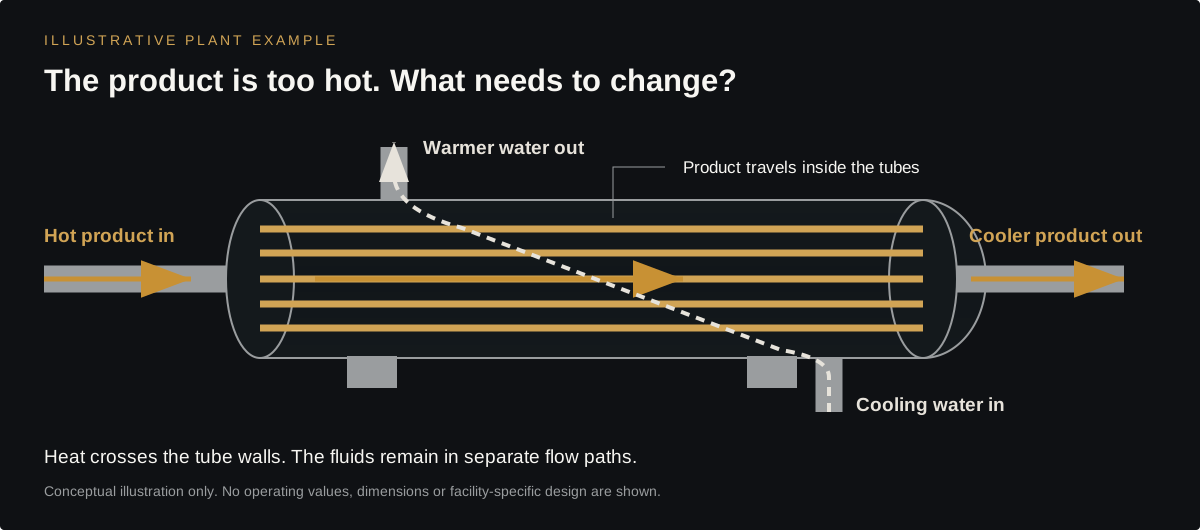
The process investigation asks how much cooling the production system needs. Has the incoming material become hotter? Is more flowing through? Has performance deteriorated, or has the production requirement changed?
The chemical perspective asks how the material behaves at those temperatures and what the downstream product requires. The mechanical perspective examines the equipment's condition and whether cleaning, repair, or modification is suitable. One engineer may cover several questions; others need specialists.
Deposits can form an insulating layer on heat-transfer surfaces. If fouling is the problem, the answer might be cleaning rather than replacement. Alternatively, the evidence may show that the original equipment no longer meets the production requirement.[4]
For a supplier, two arguments must connect: what operating problem would the proposed work solve, and how would the equipment or service solve it without creating an unacceptable maintenance problem?
Early experience: learning the process and the organization
A genuinely early-career engineer is learning more than equipment and calculations. They are also learning where reliable information lives, which standards apply, what their manager expects, and whom to consult when records do not explain a problem. Research on newly hired engineers describes both job-related learning and learning through workplace relationships.[5]
In the cooler example, someone handling the problem for the first time might need a dependable baseline. What did normal performance look like? Which measurements can be trusted? Has anyone investigated the apparent loss of cooling?
The supplier's useful contribution could be an application review, a clear explanation of assumptions, or a comparison with documented operating conditions. Help establish the problem before asking the engineer to support a purchase.
That does not mean talking down to them. They may understand the science very well. The missing context may be this equipment, this operating history, or this organization's review process.
What have you already ruled out, and which part of the evaluation would benefit from additional application evidence?
Relevant experience: evaluating what should change
An engineer with relevant operating experience may bring a different question. Suppose they participated in an earlier cleaning program and know that performance improved only briefly. They may already understand the basic heat-transfer problem. What they need is evidence that the proposed approach would produce a different result.
Repeating an introductory presentation misses the issue. Examine the previous intervention, the proposed mechanism of improvement, the assumptions, and how alternatives would be compared. Cleaning cost and the cost of deteriorating performance are connected considerations in exchanger maintenance planning.[4]
The seller's contribution shifts from explaining the application to helping test a decision.
This is the commercial hypothesis behind studying tenure: relevant experience may change what someone needs from a supplier. Elapsed time gives a reason to investigate experience; it does not prove which projects the person worked on or how much influence they have.
Established experience: helping a change get considered
A technically sound idea still needs a path through the organization. An engineer who has helped evaluate modifications may know which operating concerns must be addressed, what maintenance evidence is missing, and why an earlier recommendation stalled.
For that conversation, prepare more than a product comparison. The useful package may include the operating benefit, supporting calculations, implementation constraints, unresolved risks, and a way to check the result.
The distinction is demonstrated technical credibility and participation in decisions, not an assumed purchasing limit. Workplace relationships and local expectations matter to how engineers learn to contribute within an organization.[5]
Ask what the engineer has actually helped change and what evidence would be needed this time. Support that process instead of assuming an interested contact is already an internal sponsor.
New to the role does not mean new to engineering
Consider three illustrative contacts who recently started Process Engineer positions. One is a graduate in a first engineering job. Another is an internal transfer with substantial experience elsewhere in the company. The third is an experienced engineer joining a new employer.
All three are new to the position. They are not equally new to technical work or the organization. Research on engineering newcomers distinguishes recent graduates from experienced new hires.[5]
The graduate may benefit from application context and help with a first evaluation. The internal transfer may need an explanation of the new unit rather than company procedures. The experienced external hire may need local history and standards, not an introductory engineering lesson.
Current role
What is new about this assignment?
Current employer
What do they know about this organization?
Earlier career
Which relevant problems have they worked on?
These questions require the person's actual history. Missing history remains unknown, not evidence of inexperience. No fixed number of years automatically makes someone a learner, influencer, or decision-maker.
Match the help to the conversation
For someone learning an application, provide clear explanations and dependable resources. For someone evaluating alternatives, provide comparisons and assumptions that can withstand scrutiny. For someone with a demonstrated role in advancing a change, help assemble the technical case and resolve the questions other participants will raise.
The objective is not to label engineers by years served. It is to stop giving the same presentation to people who need different kinds of help.
Put the research to work
Bring one account. Leave with better questions.
Walk through a target organization, examine current roles and career histories, and identify which responsibilities still need verification before the next technical meeting.
Sources and research method
Role definitions use the educational and technical references below. Operating scenarios are illustrative. Seller applications are editorial interpretation, not measured adoption outcomes or a certification by practicing engineers.
Public tenure findings use current matching Evidence Passports. Current-role tenure requires month-precision chronology. Employer tenure requires one unambiguous employer and continuous same-employer intervals, with a three-month continuity tolerance. A later return after a larger gap starts a new episode. Missing histories are excluded, not estimated.
These are recorded role mappings, not an industry census. Current tenure is elapsed time so far, not completed job duration or a turnover forecast. Separate medians do not describe paired careers. Aggregate findings do not establish personal purchasing, budget, reporting, or specification authority.
- IChemE: Chemical engineering job titles and the work they describe
- IChemE: Chemical Engineering for Other Engineers
- Michigan Technological University: Mechanical engineering
- Ipieca: Heat exchangers and energy efficiency
- Korte: How newcomers learn the social norms of an organization through interactions with coworkers