Where Industrial Buying Centers Changed in September 2026
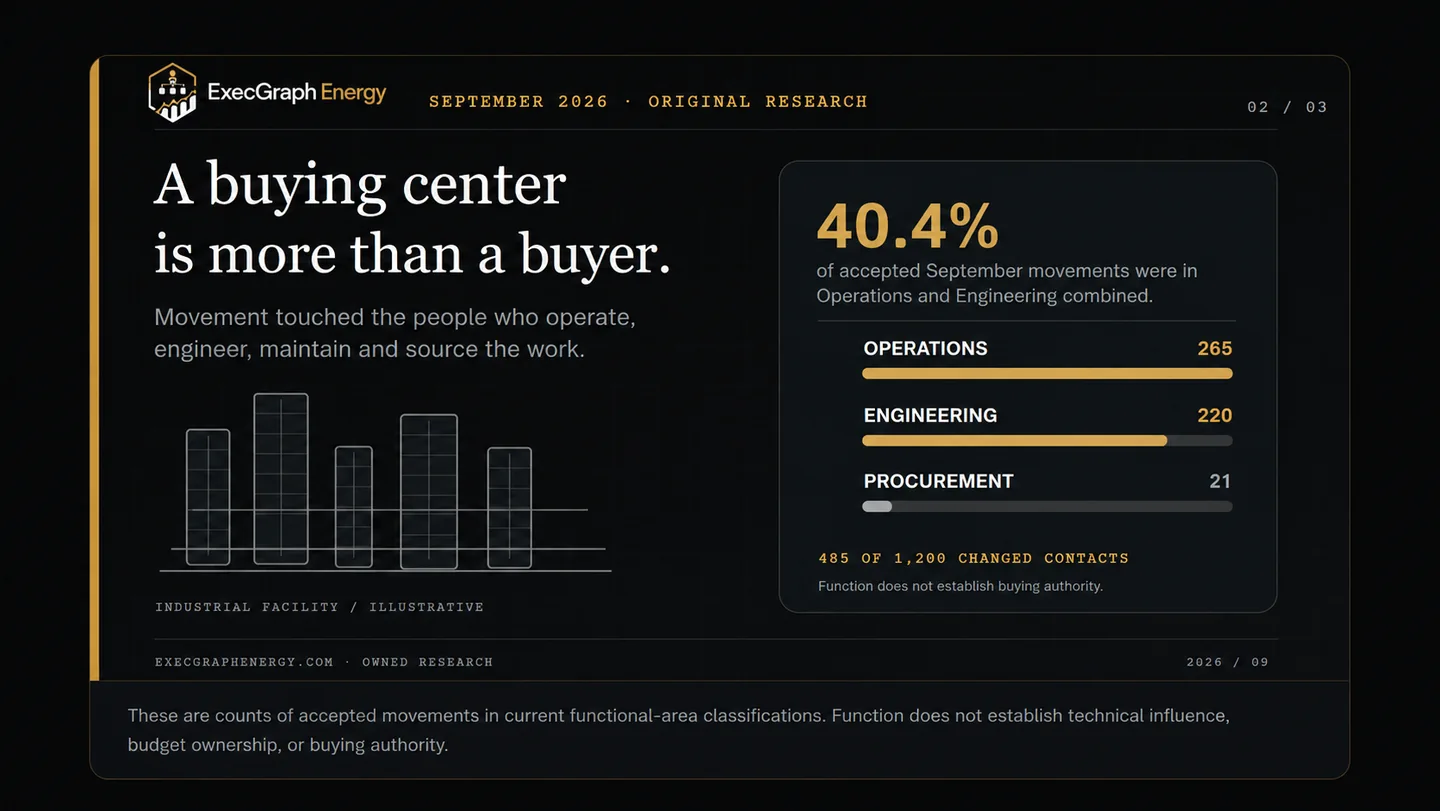
Among 1,200 Energy contacts with accepted movement detected in September 2026, Operations accounted for 265 and Engineering for 220. Together they represented 40.4% of all changed contacts, showing that buying-center maintenance cannot be limited to procurement records.
Industrial buying centers do not become stale only when the buyer changes jobs.
Operations moves. Engineering moves. Maintenance moves. Reliability moves. Project teams move.
ExecGraph's September 2026 change ledger makes that visible. Among 1,200 Energy contacts with accepted meaningful movement detected during the month, 265 were in Operations and 220 were in Engineering.
Together, those two functions accounted for 40.4% of all changed contacts.
The buying center moved most in Operations and Engineering
Operations and Engineering were the two largest named functional areas in the September change set.
That matters because many industrial sales teams maintain their account data as if procurement were the primary point of decay.
September's data shows a broader problem. The people defining the operating need and technical scope were moving at a much larger absolute volume than the people in Procurement.
A seller who updates only the buyer list can still be working from an outdated buying center.
Operations movement was driven by employer changes
Within Operations, 116 contacts had a company change detected. Another 76 had a title change, 43 a promotion, 22 a departure, and eight a lateral move.
For account coverage, company changes are especially important because they alter two networks at once. The old facility can lose a familiar operating contact, while the person's new employer may gain someone who already knows the vendor.
The signal is not “call them immediately.” The signal is “remap both accounts.”
Engineering movement looked different
Engineering had 220 changed contacts, but the mix was more evenly divided.
Title changes touched 82 Engineering contacts, slightly more than the 80 company changes. Promotions affected 44. Departures affected 11, and lateral moves three.
That pattern is important because an engineer can remain at the same employer while moving closer to, or farther from, the technical decision a seller cares about.
Company continuity does not guarantee responsibility continuity.
Maintenance and reliability movement is smaller but commercially concentrated
Maintenance contributed 45 changed contacts. Manufacturing & Reliability contributed 21.
Those are smaller populations than Operations or Engineering, but they sit directly inside many MRO, repair, reliability, turnaround, and equipment decisions.
In Maintenance, 21 of the changed contacts were company changes, 11 title changes, and 10 promotions. In Manufacturing & Reliability, 13 were company changes and six promotions.
For a seller carrying a live repair or reliability pursuit, even one of those movements can change who diagnoses the problem, who owns the work, or who can bring the vendor into the next conversation.
Supply Chain and Procurement were not static either
Supply Chain had 26 changed contacts and Procurement 21.
Supply Chain's September mix included 10 company changes, nine title changes, and six promotions. Procurement included 10 company changes, three title changes, six promotions, one departure, and one lateral move.
This is the commercial side of buying-center drift: the technical team may still want the same solution, while the person who knows the contract, supplier status, or transaction path has changed.
Projects created another moving layer
Projects & Construction had 22 changed contacts. The separate Projects classification had 21.
That matters because project pursuits often cross operating and capital organizations. The account map that worked during project development may not match the team that owns construction, commissioning, startup, or handover.
More than half of the changed contacts sat in eight core pursuit functions
Operations, Engineering, Maintenance, Supply Chain, Projects & Construction, Manufacturing & Reliability, Procurement, and Projects together accounted for 641 of the 1,200 changed contacts.
That is 53.4% of all accepted September movement.
The conclusion is not that every one of those people is a buyer. The conclusion is that the functions surrounding industrial decisions move continuously enough that a buying center should be maintained as a living structure, not rebuilt only when a deal stalls.
September movement by function
| Function | Changed contacts | Largest movement class |
|---|---|---|
| Operations | 265 | Company change · 116 |
| Engineering | 220 | Title change · 82 |
| Maintenance | 45 | Company change · 21 |
| Supply Chain | 26 | Company change · 10 |
| Projects & Construction | 22 | Company change · 10 |
| Manufacturing & Reliability | 21 | Company change · 13 |
| Procurement | 21 | Company change · 10 |
| Projects | 21 | Company change · 11 |
Data source and methodology
Production snapshot queried October 17, 2026. Population: 1,200 distinct Energy contacts with accepted company, title, promotion, lateral-move, or departure changes detected from September 1 through September 30, 2026.
Functional area is the current ExecGraph classification on the contact record at query time. Pending-confirmation, review-required, and needs-human-review change records were excluded. A contact can appear in more than one change class, but each functional-area headline count is a distinct contact count.
Functional-area membership is not a claim of budget, specification, sourcing, or purchasing authority. No contact names or private pursuit records are published. See ExecGraph methodology for the evidence framework.
Underlying research figures
Review the downloadable, machine-readable aggregate figures behind this analysis. ExecGraph publishes these observations and their measurement limitations, not private contact identities, raw relationship edges, or customer-specific pursuits.
Questions Answered
Which functions had the most detected contact movement in September?
Operations had 265 changed contacts and Engineering had 220. Together they represented 485 of the 1,200 accepted changed contacts, or 40.4%.
How much movement appeared in maintenance and commercial buying functions?
Maintenance had 45 changed contacts, Supply Chain 26, Procurement 21, Manufacturing & Reliability 21, Projects & Construction 22, and Projects 21.
What kind of movement was most common in Operations?
Company changes were the largest Operations class at 116 contacts, followed by 76 title changes, 43 promotions, 22 departures, and eight lateral moves.
Does a functional-area change count prove buying authority?
No. Functional area describes where the contact sits in the organization. Buying authority, technical influence, budget ownership, and purchase release remain separate evidence questions.
Explore the decision chain at the facilities mentioned above
ExecGraph organizes 47,000 industrial business records across 1,300 organizations in 12 markets. Record-level source, date, and confidence can vary by pursuit.
Request accessAccess requests are reviewed before an account is activated.