The people and decisions behind industrial equipment sales
First-party movement research, role-level buying-center intelligence and grounded plant examples for manufacturers, distributors and service providers selling industrial equipment.
What the people behind plant decisions are doing
We examined the contact history since the database began accumulating observations. See what ExecGraph can support about retirements, new-hire claims, job changes and the engineers or managers who shape equipment decisions.
How plant buying decisions change when people move
Three connected investigations into refinery, power and LNG equipment decisions. See how process engineers, reliability teams and maintenance managers influence the purchase path, and why current relationships matter more than a static plant list.
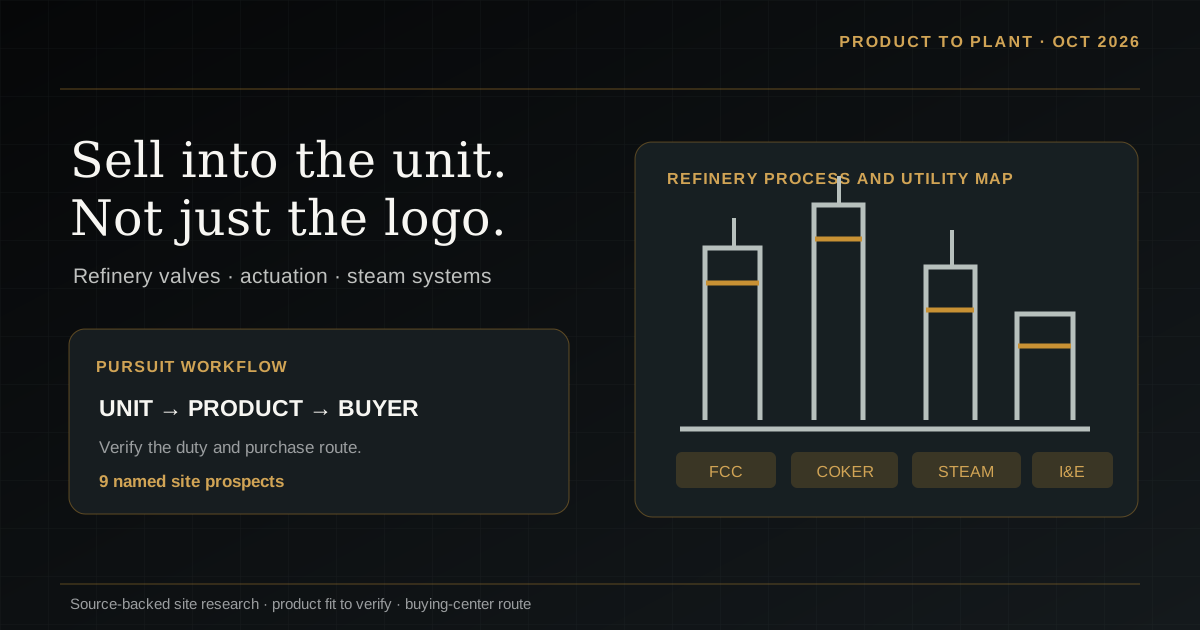

How refinery engineering and maintenance shape the sale
1,808 process engineers · 455 reliability engineers · 264 maintenance managers
A connected explanation of the technical, reliability, maintenance and sourcing decisions behind a refinery equipment sale.
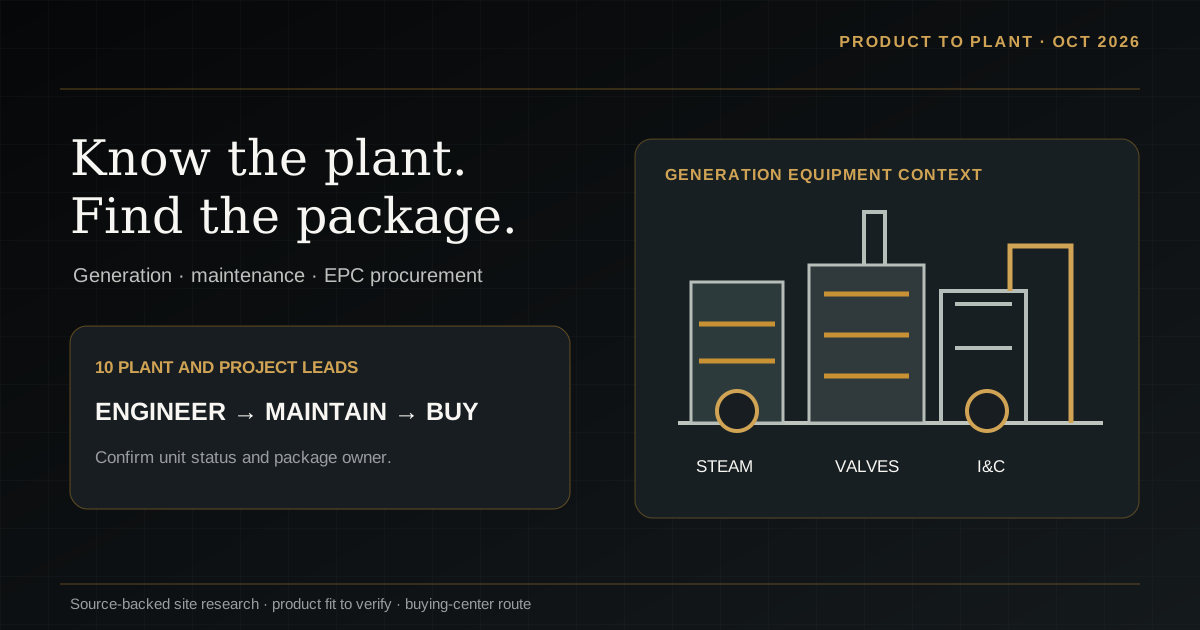
Why power plant buyers change after commissioning
33 reliability · 31 maintenance role contacts with screened movement
Follow a valve or steam product from project handover to the operating station's maintenance and reliability team.
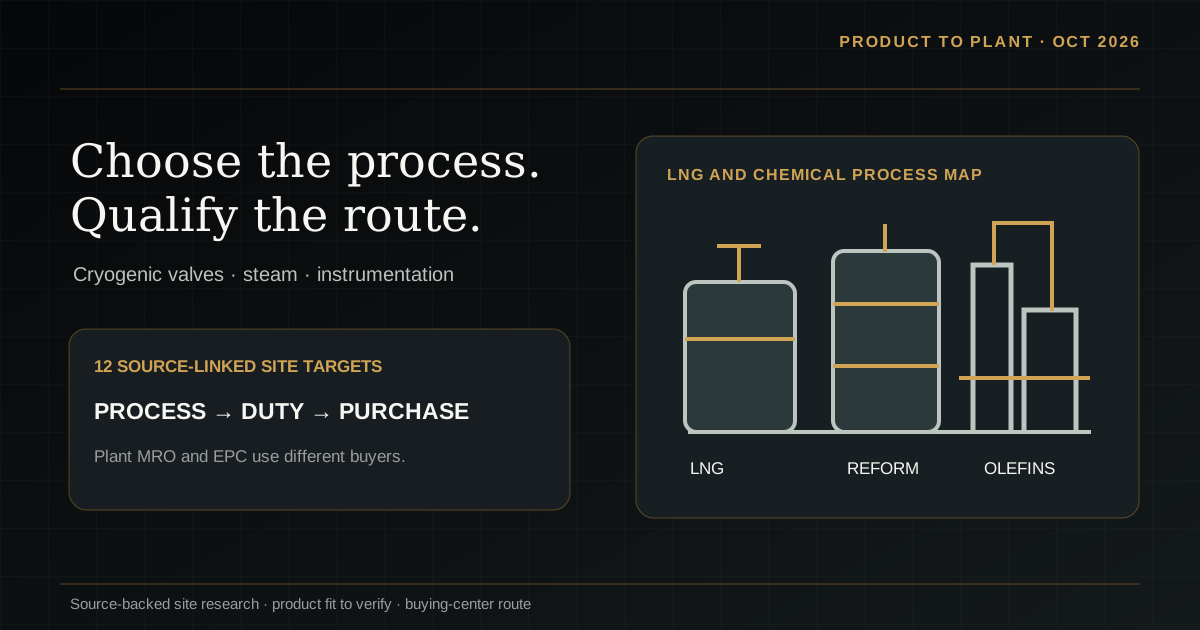
Why process engineers matter in LNG and chemical sales
1,808 process engineers; 137 with screened movement signals
How engineers define equipment duty, technical acceptance and the route from specification to purchase in LNG and chemical plants.
People moved. Buying centers changed. Relationships deepened.
Three findings from ExecGraph’s accumulated research, moving from daily verification to industrial buying-center changes and the emerging potential of a learned relationship graph.
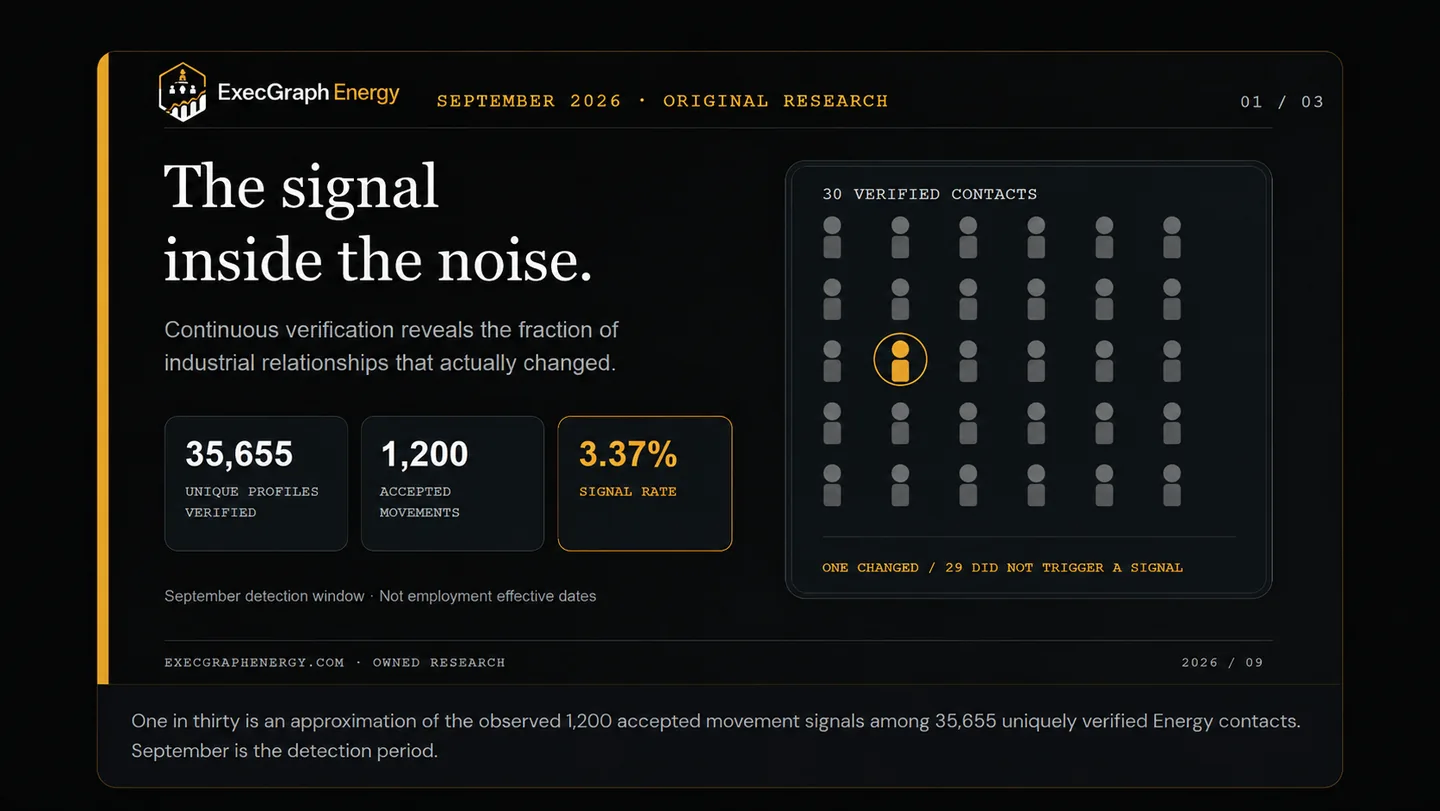
One in 30 verified contacts moved
3.37% produced a meaningful movement signal
What 35,655 verified profiles reveal about the practical yield of continuous research.
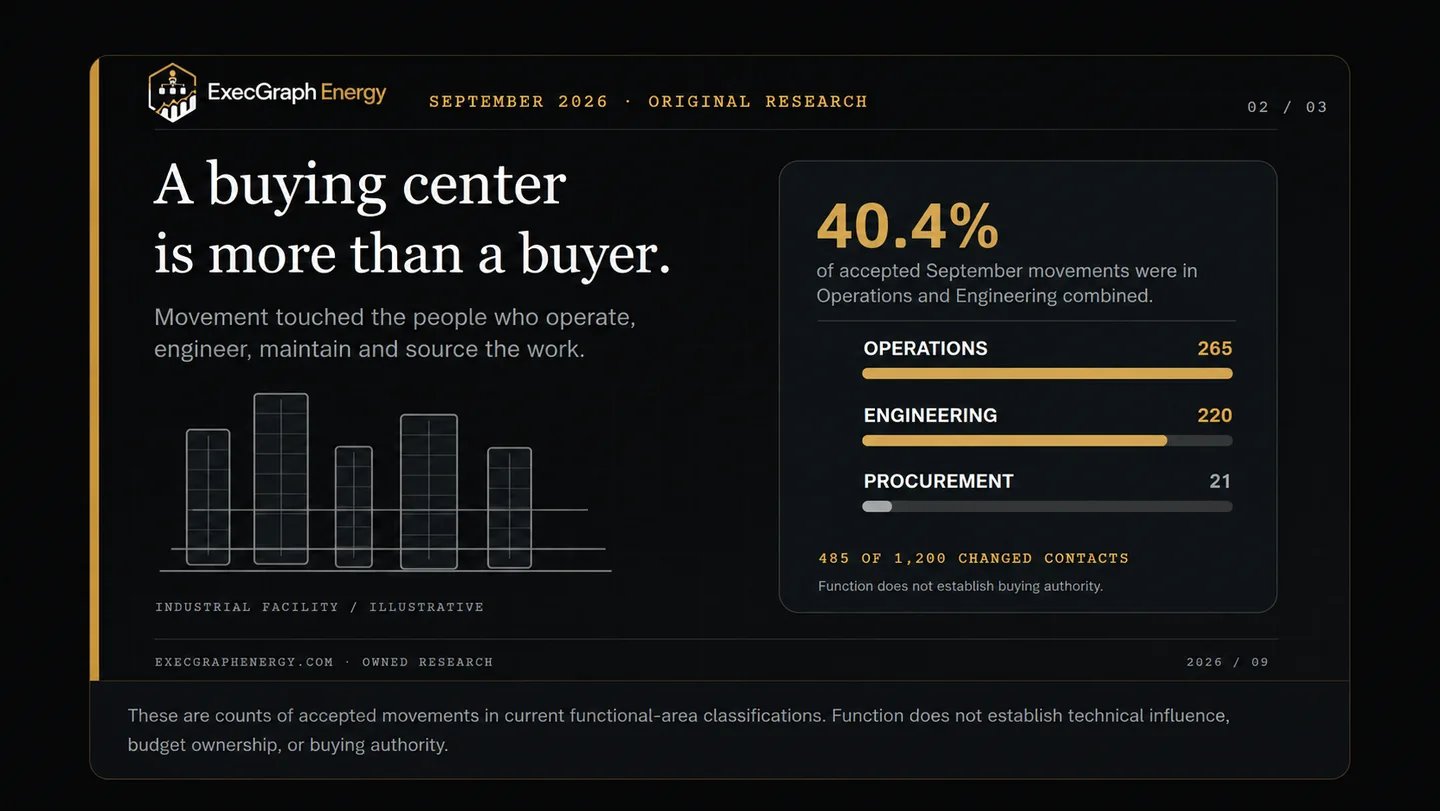
Change extends beyond Procurement
40.4% sat in Operations and Engineering
How movement across eight industrial functions changes the territory picture.
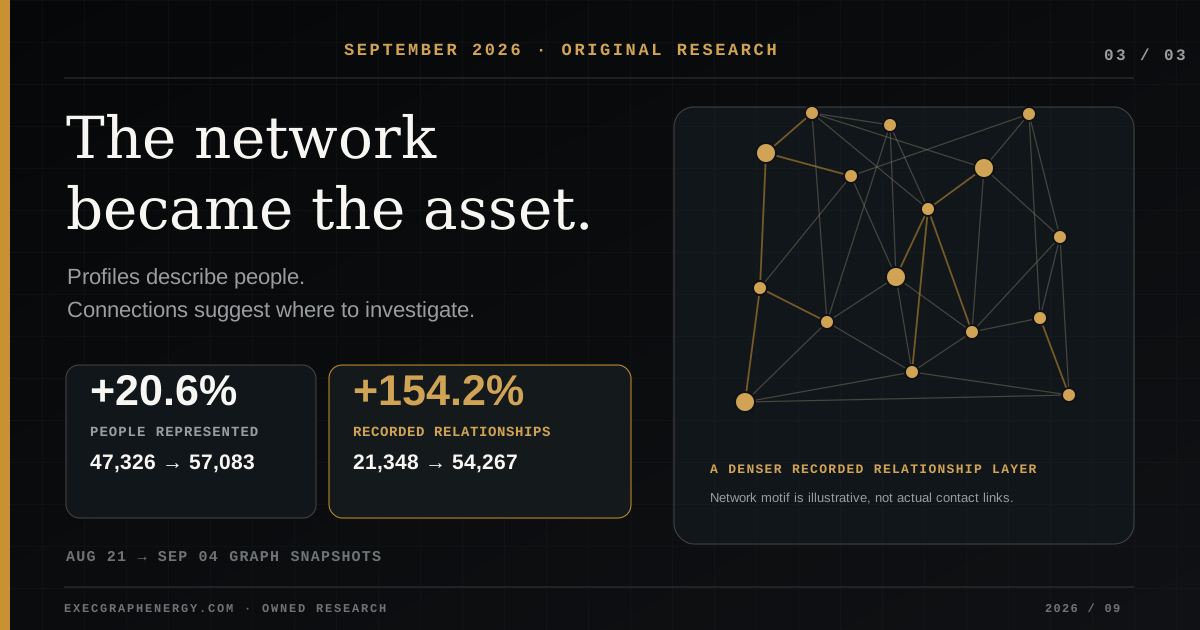
Relationships outpaced contact growth
154.2% growth in recorded relationships
Why a deepening graph could enable stronger Warm Path candidate testing.
More industrial intelligence
What Seven Months of Energy Contact Research Reveal About the People Behind Plant Decisions
ExecGraph's March to October 2026 Energy research separates retirement, career movement, new-hire labels and the reliability, process and maintenance roles sellers must cover.
Maintenance Planner vs. Reliability Engineer: Who Should an Industrial Vendor Call First?
A reliability engineer and a maintenance planner can both care about the same pump. Department of Energy separates maintenance strategy from maintenance planning for a reason. Neither reliability nor planning owns the equipment in a vacuum.
Critical Spares: Who Decides What an Industrial Plant Keeps on the Shelf?
The easiest way to oversell spare parts is to call everything critical. That tension is the real critical-spares conversation. The critical-spares list still has to be earned equipment by equipment.
Why Industrial MRO Orders Get Stuck After the Technical Decision
A plant can agree that it needs the part or service and still be unable to issue an order. Supplier eligibility, agreement coverage, quote accuracy, requisition setup, purchase-order release, receiving, and invoice matching can each stop an otherwise valid MRO purchase.
Who Buys Data Center Liquid Cooling? Map the Decision Before You Quote
If you are asking, “Who buys liquid cooling?” you may already be compressing five different decisions into one question. A data center can have a real need for direct liquid cooling and still be months away from a purchase. Its CDU work specifically focuses on integrating advanced cooling solutions into data center facilities through liquid distribution.
Announced, Permitted, or Under Construction? How Vendors Qualify a Data Center Project
Those statements sound obvious, but data center pipelines fill up with projects that are real in one sense and useless in another. Aligned Data Centers, for example, publicly announced that it broke ground on Project Caprock in Texas. ExecGraph's public data-center intelligence only surfaces matched permit activity when the internal review flag is clear and the permit-to-project match confidence is at least 0.90.
ExecGraph Energy Buying-Team Changes: What We Detected in September 2026
ExecGraph detected at least one accepted company, title, promotion, lateral-move, or departure classification for 1,200 distinct Energy contacts in September 2026 after excluding pending and review-required events. These are detection records, not claims that every career move occurred during September.
Corporate Agreement, Local Purchase Order: How to Expand from One Industrial Plant to the Next
A corporate agreement can open a door, but it does not prove that the next plant needs your product, accepts your company for that scope, or will issue a purchase order. Treat each facility as a new commercial decision with its own operating need, local stakeholders, and transaction path.
EPC or Operator? How the Buying Center Changes as an LNG Project Starts Up
Understand how LNG buying responsibilities can change from EPC execution through commissioning, startup, and steady operations without assuming one team owns every…
Who Owns a Steam System Efficiency Project at an Industrial Plant?
A steam issue can begin as a maintenance task and become a plant level energy project. Before selling a system wide solution, separate the local repair, the system assessment, the business case, the project funding decision, and the purchasing path.
Refinery Maintenance MSAs: How to Prepare for a Rebid Before the RFQ
Do not start with the operator name and call the opportunity “plant services.” Start with the facility and the actual service category. Scaffolding, insulation, mechanical maintenance, inspection, and instrumentation can follow different qualification and buying paths even inside the same complex. Its public sourcing information separately discusses safety systems, capable personnel, equipment, and other qualification considerations.
After the Turnaround: How Contractors Build the Case for Recurring Maintenance Work
The most useful follow up after a turnaround starts with a clean closeout and a conversation about what remains. Separate work you already owe from a possible new need, confirm who owns that need after startup, and agree on the next decision before proposing an ongoing maintenance program.
Who Approves a Rotating Equipment Repair Scope at a Refinery?
For a rotating equipment repair, check who accepts the diagnosis and scope, who controls the work window, who owns the cost center for the work, and who releases the purchase. Confirm the actual responsibilities at the facility rather than assigning authority from a title.
Gulf Coast Turnaround Season: 5 Questions Every Vendor Should Ask Before 2027
The practical questions vendor sales teams should answer before the unit comes down and the purchase path closes.
How ExecGraph Maps the Facility Decision Chain Before the First Meeting
How does ExecGraph map the buying center at a Gulf Coast facility? The verified decision chain from entry contact to budget owner, and why it helps suppliers and producers on both sides.
How Warm Path Connections Turn Cold Outreach Into Trusted Introductions
How do warm path connections work? Shared employer history turns cold outreach into trusted introductions, and reconnects producers with partners they already know.
How ExecGraph Turns Coverage Gaps Into an Advantage
How does ExecGraph handle coverage gaps? It flags unverified roles as technical or procurement gaps, focuses supplier effort, and connects overlooked facilities to real solutions.
How Domain Configured Intelligence Matches Products to Facilities
How does domain configured intelligence match products to facilities? Analysis tuned to a plant's process units, equipment, and turnaround windows surfaces the right fit for both sides.
How ExecGraph Connects the Gulf Coast Market: People, Companies, and Opportunities
How does ExecGraph connect the Gulf Coast market? A living, continuously verified graph of producers and suppliers that turns guarded accounts into a market working both ways.
Marathon Garyville 2027 Turnaround Outlook: Capital Expansion Meets Maintenance Cycle
The Marathon Garyville turnaround 2027 question sits at the top of the Louisiana pursuit list for industrial vendors, and for good reason. All of this is cycle inference: no unit level 2027 turnaround at Garyville has been announced, and this article does not assert one.
ExxonMobil Baton Rouge 2027 Maintenance Window: The Staggered Gulf Coast Cycle
The ExxonMobil Baton Rouge turnaround question for 2027 is really a question about how ExxonMobil sequences maintenance across its Gulf Coast system. The staggered read is straightforward: with Beaumont's reported program running through January 2027, Baton Rouge becomes the plant in the ExxonMobil Gulf Coast system with the longest runway since its last major cycle · and the natural candidate for the next window.
Sasol Lake Charles: What Comes After the 2026 Steam Cracker Turnaround
The Sasol Lake Charles turnaround picture heading into 2027 turns on a simple structural fact: the complex is not 1 plant, it is a network of production facilities that cycle on independent clocks. ExecGraph tracking lists a possible steam cracker turnaround at Sasol Lake Charles in mid 2026, and the question vendors are already asking is what comes after it. ExecGraph tracking lists a possible steam cracker turnaround at Sasol Lake Charles in mid 2026.
CITGO Lake Charles 2027: Life After the 2024 CDU Turnaround
The CITGO Lake Charles turnaround cycle reset in the spring of 2024, and understanding exactly what was turned around then is the key to reading what comes next. For vendors building a CITGO Lake Charles 2027 plan, the 2024 scope defines which units are freshly cycled and which ones carry forward toward the next window.
Shell Norco 2027: Ethylene and Petrochemical Cycles After the 2025 RCCU Overhaul
The Shell Norco turnaround completed in the fall of 2025 reset the refining side of one of the River Parishes' anchor facilities, and the question for vendors now is what the site's chemical side does next. This article covers what the 2025 event included, why the chemicals complex points independently into 2027, and the sourcing structure at Norco that vendors most often underrate when planning a Shell Norco 2027 pursuit.
How to Sell Into Louisiana Turnarounds in 2027: The 18 Month Procurement Window
How to sell into Louisiana turnarounds is, at its core, a timing question. No 2027 turnaround at Garyville is confirmed. A 2027 maintenance window there is a staggered cycle inference at medium to low confidence · ExxonMobil's reported 2026 turnaround activity concentrated at Beaumont · and it deserves to be framed exactly that way.
ISNetworld and Vendor Prequalification at Louisiana Refineries by Corridor
How ISNetworld and vendor prequalification differ across Lake Charles, Baton Rouge, the River Parishes, and New Orleans, and why an internal sponsor matters.
The Contact Turnover Problem in Louisiana Energy: Why Your Turnaround Prospect List Goes Stale
Why Louisiana turnaround prospect lists go stale, how planners and reliability engineers rotate across Gulf Coast facilities, and what the moves signal.
The Procurement Categories That Drive Louisiana Turnaround Spending
The procurement categories that drive Louisiana turnaround spending: rotating equipment, heat exchanger bundle work, valves, and who buys each category.
Spring vs Fall Turnarounds in Louisiana: Timing Your Sales Cycle
When turnaround season hits Louisiana: the spring and fall windows, the EIA utilization evidence, and how vendors time a sales cycle around the calendar.
Louisiana's Four Industrial Corridors: How Turnaround Markets Differ
Louisiana's industrial corridors are often discussed as if they formed a single market, but vendors who sell into turnarounds learn quickly that the state runs on four distinct systems: the Lake Charles corridor in the southwest, the Baton Rouge corridor at the head of the lower Mississippi, the River Parishes stretch between Baton Rouge and New Orleans, and the greater New Orleans corridor downriver.
Gulf Coast Refinery Utilization Reset and What It Means for 2027 Turnaround Spending
This article lays out what utilization actually did in 2025, why strong refining margins and weak petrochemical margins pushed maintenance in opposite directions, and what the resulting pile up suggests about 2027 turnaround spending in Louisiana. Gulf Coast refiners and Gulf Coast chemical operators lived through opposite 2025 stories, and the difference matters for anyone forecasting 2027 turnaround spending.
Sasol Lake Charles vs Dow St Charles: Chemical Plant Turnaround Procurement Models
Sasol Lake Charles and Dow's Louisiana complexes represent the two dominant chemical plant turnaround procurement models a vendor encounters in the state: 1 operator running a single integrated site with centralized turnaround management, and 1 operator running two separate complexes with distinct maintenance teams. Charles Operations at Hahnville, in the River Parishes, is a 2,000 acre site that has been operating since 1966 and was historically a Union Carbide complex, a Dow subsidiary.
The Marathon Garyville Expansion: How Capital Projects Create Parallel Turnaround Opportunities in 2027
The Marathon Garyville expansion program disclosed with Marathon Petroleum's fourth quarter 2025 earnings puts two capital projects on the clock at the largest refinery in Louisiana, both targeted online by the end of 2027. Marathon Petroleum's Q4 2025 earnings guidance, released February 3, 2026, described two Garyville projects.
Air Products Cancels Louisiana Clean Energy Complex: What It Means for Contractor Capacity in 2027
The Air Products Louisiana cancellation announced on June 30, 2026 removed one of the largest capital projects in the state from the construction pipeline. It changes the supply side of the contractor capacity equation heading into the 2027 turnaround seasons. Set the two moves side by side: demand for craft labor in South Louisiana was building into 2027 regardless, and the supply picture just improved by one megaproject's worth of committed capacity.
Predictive Maintenance vs Fixed Interval Cycles: How Louisiana Refineries Schedule Turnarounds
Predictive maintenance is reshaping how Louisiana refineries schedule turnarounds. For decades, facilities including CITGO Lake Charles, Shell Norco, ExxonMobil Baton Rouge, and Marathon Garyville planned major maintenance on fixed interval cycles, with each process unit coming down every 4 to 6 years largely regardless of its measured condition.
Why Louisiana Turnarounds Are Harder to Win Than Texas
Why Louisiana turnarounds are harder for vendors to win than Texas events: four separate corridors, real distance from Houston, and thinner local coverage.
Digital Twins and 3D Documentation in Louisiana Refinery Turnarounds
Laser scanning, reality capture, and digital twin platforms exist to close that gap before the event starts rather than during it. A digital twin, defined simply, is a maintained digital replica of a physical asset that combines 3D geometry, usually captured by laser scanning, with engineering data such as line lists, equipment records, and inspection history, kept current enough to make decisions against.
Turnaround Safety Performance at Louisiana Facilities: What Zero Incident Events Look Like
What strong turnaround safety performance looks like in Louisiana: the Sasol 2021 zero recordable benchmark, weld pass rates, and headcount management.
Turnaround Scope Freeze and the Cost of Late Additions
What a turnaround scope freeze is, why best practice sets it 18 to 24 months out, and why late scope additions drive most cost overruns at Louisiana refineries.
Gulf Coast Turnaround Contractors: Who Wins the Work and Why
Gulf coast turnaround contractors form the operational backbone of every major refinery maintenance event along the Texas and Louisiana corridor. Turner Industries, headquartered in Baton Rouge, Louisiana, is one of the largest industrial contractors in the Gulf Coast region with a turnaround services division that operates across refining, petrochemical, and power generation facilities in Texas and Louisiana.
How Service Contractors Win Turnaround Scope at Gulf Coast Refineries
How service contractors win turnaround scope at Gulf Coast refineries is not primarily a bidding question. The contractors who consistently win turnaround work have positioned themselves as known quantities at the facility long before the formal bid process opens. Routine maintenance work at a refinery is the most common entry point for contractors seeking turnaround scope.
Refinery Contractor Prequalification: ISNetworld, Avetta, and What They Mean for Vendor Access
Refinery contractor prequalification through platforms such as ISNetworld, Avetta, and Veriforce is a prerequisite for performing work at virtually every major Gulf Coast refinery and petrochemical plant. Initial setup requires uploading foundational documents: corporate safety program, drug and alcohol testing program, environmental management program, quality assurance program (if applicable), insurance certificates of liability, workers compensation certificates, and company financial information.
Gulf Coast Turnaround Labor and Craft Availability: What Vendors Need to Know
Gulf coast turnaround labor availability is the constraint that shapes every other decision in the turnaround planning process. The Gulf Coast craft labor market for industrial turnarounds is tighter than it has been in at least a decade, and the dynamics driving that tightness are structural rather than cyclical.
Specialty Turnaround Contractors: Catalyst, Scaffolding, and Refractory
While general mechanical contractors handle the broad piping, vessel, and exchanger scopes that constitute the majority of turnaround labor hours, specialty contractors provide the technical capabilities that general contractors typically do not self-perform: catalyst handling and loading, refractory installation and repair, and scaffold erection and dismantling.
Gulf Coast Turnarounds 2027: The Complete Vendor Outlook
The ExxonMobil Beaumont refinery FCCU turnaround is the only Gulf Coast event in the 2026-2027 window that carries confirmed status. Several crackers in the Texas and Louisiana Gulf Coast corridor last turned around in the 2021-2023 period, placing them in plausible 2027 windows by cycle alone. The only Gulf Coast refinery event confirmed for the 2026-2027 window is the ExxonMobil Beaumont FCCU turnaround, running December 2026 into January 2027.
The 2027 Petrochemical Cracker Turnaround Wildcard
For 2027, several steam crackers in Texas and Louisiana sit in plausible turnaround windows based on cycle history and indirect signals. Four cracker complexes in Texas and Louisiana show the combination of cycle timing and available signals that places them in a 2027 turnaround window at some confidence level.
Marathon Galveston Bay and Garyville: 2026-2027 Turnaround Signals
For Galveston Bay and Garyville, those two signal types are: capital expenditure patterns consistent with reinvestment ahead of a turnaround, and cycle timing based on the intervals between prior confirmed major turnaround events at each site. No Marathon Galveston Bay turnaround date has been confirmed as of July 2026.
Why 2027 Turnaround Procurement Starts in 2026
Procurement for a 2027 Gulf Coast refinery turnaround is already underway. Long lead items, services timelines, and why vendors who wait until 2027 will miss the…
How Refinery Turnaround Timing Is Predicted: Permits, Capital Spend, and Cycles
Operators manage the disclosure timing to balance regulatory compliance with competitive confidentiality. TCEQ filings have been used by analysts for years as a confirmation mechanism for turnaround timing. Confidence tiers reflect the weight and convergence of available evidence for a specific facility and timing window.
ExxonMobil Beaumont FCC Turnaround 2026-2027: What Vendors Need to Know
The ExxonMobil Beaumont FCC turnaround is the only confirmed major Gulf Coast refinery turnaround event in the 2026-2027 planning window. The ExxonMobil Beaumont FCCU turnaround begins in December 2026 and extends into January 2027. As of July 2026, the ExxonMobil Beaumont FCCU turnaround is the only Gulf Coast refinery or petrochemical turnaround event that carries confirmed status for the 2026-2027 window.
Inside the Beaumont FCC Turnaround: Units, Scope, and Timeline
Inside the Beaumont FCC turnaround, the scope spans three process units, dozens of major equipment items, and hundreds of individual work orders executed in a compressed timeline. Understanding the units involved, the major scope categories, and the turnaround timeline from pre-shutdown through startup gives vendors the context needed to identify where their products and services fit within the event and when procurement decisions are made for each scope category.
Beaumont Turnaround Buying Center: Who Awards Scope
Who controls vendor selection and scope award at the ExxonMobil Beaumont refinery turnaround? A map of the buying center from the turnaround manager through procurement, engineering, and operations.
Beaumont FCC Procurement Gates: AML, MRC, and API Standards
How the procurement process works for the ExxonMobil Beaumont FCCU turnaround. Approved manufacturer lists, material requisition cycles, and API standard compliance as the gates that vendors must clear to participate.
What Vendors Sell Into an FCC Turnaround
What vendors sell into an FCC turnaround spans a broader range of product and service categories than most industrial sales teams realize. Control valves in FCC service operate under demanding conditions: high temperatures, erosive catalyst fines in some services, and tight control requirements for process stability. Safety relief valves (PSVs) on the FCC unit and associated equipment are pulled for recertification during the turnaround.
What Control Valves Do Gulf Coast Refineries Use?
Facilities on the Texas Gulf Coast, from the Houston Ship Channel through the Golden Triangle of Beaumont, Port Arthur, and Orange, adopt platform standards for control valves for reasons that are operational rather than commercial. Fisher, now operating under the Emerson brand umbrella, holds the largest installed base of control valves across the Texas and Louisiana Gulf Coast refining and petrochemical complex.
Pressure Relief Valves and PSVs: Who Supplies Texas Refineries
Anderson Greenwood, also under the Emerson brand umbrella via the same Pentair acquisition pathway as Crosby, is the regional standard for pilot-operated pressure relief valves (POPRVs). The National Board VR (Valve Repair) stamp, which is issued by the National Board of Boiler and Pressure Vessel Inspectors under its Repair Program, authorizes any qualified organization to disassemble, inspect, repair, lap seats, replace springs and soft goods, set, and test pressure relief valves from any manufacturer.
Refinery Catalyst Suppliers: FCC, Hydrotreating, and Reforming
Understanding who supplies FCC, hydrotreating, and reforming catalyst to Gulf Coast refineries requires understanding not just the brands involved but the technical and commercial relationships that make catalyst one of the least transactional categories in downstream procurement. A large FCC unit may consume several hundred tons of fresh catalyst per year through this addition program alone, making FCC catalyst a truly recurring consumable rather than a turnaround-cycle purchase.
Rotating Equipment at Gulf Coast Refineries: Pumps, Compressors, and Turbines
Rotating equipment at Gulf Coast refineries · pumps, compressors, and turbines · forms the mechanical backbone of every process unit from crude distillation to hydrocracking. Rotating equipment at Gulf Coast refineries sits in a procurement category that operates differently from commodity MRO, instrumentation, or structural materials.
Heat Exchangers and Fired Heaters: Who Supplies Gulf Coast Turnarounds
Heat exchangers and fired heaters are among the longest lead, most capital intensive equipment categories in a Gulf Coast refinery turnaround. John Zink Hamworthy Combustion, a Koch Industries company, is a widely recognized supplier of burners for fired heaters at Gulf Coast refineries and petrochemical plants.
Refineries on the Gulf Coast: The Complete Operator Map for Industrial Vendors
Gulf Coast refineries exist at this concentration for three reasons that compound. Gulf Coast refineries run the most complex process configurations in the world, with Nelson Complexity Indexes routinely above 12, because the economics of converting heavy sour crude into high value products justify the capital investment in coking, hydrocracking, and alkylation capacity.
Gas Plants on the Gulf Coast: The Complete Operator Map for Industrial Vendors
If you sell into gas plant operations, knowing that Enterprise Products Partners is the largest NGL fractionator on the Gulf Coast matters less than knowing which fractionation trains at Mont Belvieu are approaching a turnaround, and who at the complex controls vendor selection for your product category.
Petrochemical Companies on the Gulf Coast: The Complete Operator Map for Industrial Vendors
The Gulf Coast petrochemical corridor stretches from Corpus Christi, Texas, through Houston, Beaumont, and Port Arthur, across the Louisiana border to Lake Charles, Baton Rouge, and the Mississippi River industrial corridor. Gulf Coast petrochemical plants share common procurement categories regardless of their specific product lines.
ExxonMobil Baytown Turnaround Schedule 2026: Vendor Positioning Guide
ExxonMobil Baytown operates on a 4 to 5 year major turnaround cycle for primary refining units and a similar cadence for major olefins plant maintenance. Based on publicly disclosed maintenance spending patterns and the typical cycle length, major unit turnarounds at Baytown fall within expected windows for 2026 and 2027.
Marathon Galveston Bay Turnaround Schedule 2026: Vendor Positioning Guide
Based on cycle timing and disclosed spending patterns, major unit turnarounds at Galveston Bay fall within the 2026 to 2027 planning window. Based on cycle timing and disclosed capital spending patterns, major unit turnarounds at Galveston Bay fall within the 2026 to 2027 planning window.
Valero Port Arthur Turnaround Schedule 2026: Vendor Positioning Guide
Valero Port Arthur processes approximately 395,000 barrels per day, making it one of the largest refineries in Valero Energy 's 15 refinery system. Based on the typical cycle and disclosed spending patterns, Port Arthur falls within expected major turnaround windows for the 2026 planning horizon. Based on cycle timing and disclosed spending patterns, Port Arthur falls within expected turnaround windows for the 2026 planning horizon.
Motiva Port Arthur Turnaround Schedule 2026: Vendor Positioning Guide
Turnaround timing, vendor qualification, and procurement structure at Motiva Port Arthur, the largest single site refinery in North America at 630,000 bpd.
Phillips 66 Sweeny Turnaround Schedule 2026: Vendor Positioning Guide
Based on cycle timing and disclosed spending, Sweeny falls within expected turnaround windows for the 2026 to 2027 planning period. See the Texas refinery turnaround schedule 2026 for broader context. Based on cycle timing and disclosed spending patterns, Sweeny falls within expected turnaround windows for the 2026 to 2027 planning period.
LyondellBasell Houston Turnaround Schedule 2026: Vendor Positioning Guide
Turnaround timing, vendor qualification, and procurement structure at LyondellBasell's Houston refinery and Channelview chemical complex. Use the page to evaluate…
Gulf Coast Fall 2026 Turnaround Schedule: Every Confirmed and Expected Outage
This guide compiles confirmed and expected turnaround events across the Gulf Coast for fall 2026, organized by facility with links to detailed vendor positioning guides where available. The fall 2026 window is largely committed, but the spring 2027 and fall 2027 cycles are in early planning stages, and the vendors who engage now will be positioned when the procurement windows open.
How to Sell to ExxonMobil: Gulf Coast Vendor Strategy Guide
ExxonMobil operates one of the largest downstream footprints on the Gulf Coast. For industrial vendors selling turnaround services, rotating equipment, inspection technology, valve services, or specialty chemicals, landing an ExxonMobil account is a career defining opportunity. This guide covers the operational landscape, procurement structure, decision authority, and practical entry points for vendors targeting ExxonMobil Gulf Coast operations.
How to Sell to Marathon Petroleum: Gulf Coast Vendor Strategy Guide
Marathon Petroleum is the largest refiner in the United States by throughput capacity, operating 16 refineries with a combined system capacity exceeding 3 million barrels per day. For Gulf Coast vendors, Marathon represents one of the most significant potential accounts in the downstream sector. Marathon's refining system spans the Gulf Coast, Midwest, and West Coast, but the Gulf Coast facilities are the primary targets for regional vendors.
How to Sell to Valero Energy: Gulf Coast Vendor Strategy Guide
Valero Energy is the largest independent refiner in the world, operating 15 US refineries with a combined throughput capacity of approximately 3.2 million barrels per day. For Gulf Coast vendors, Valero is distinctive because of its decentralized procurement model. The most important thing to understand about selling to Valero is that procurement is decentralized.
ExxonMobil Procurement and Buying Center: Who Controls Vendor Selection
This guide maps the ExxonMobil buying center at Gulf Coast facilities, identifies the Senior Role functions that control vendor selection, and explains the three distinct buying paths that vendors need to understand. Vendor procurement at ExxonMobil flows through three distinct buying paths, each with different timelines, decision makers, and entry strategies.
Marathon Petroleum Procurement and Buying Center: Who Controls Vendor Selection
Marathon Petroleum is the largest refiner in the United States, and its procurement organization reflects that scale. This guide maps the Marathon buying center, explains the corporate vs site split, and identifies the decision functions that control vendor selection at Gulf Coast facilities. Before any buying center discussion, vendors need to understand that Marathon operates a hard gate on ISNetworld compliance.
Valero Procurement and Buying Center: Who Controls Vendor Selection
The buying center at each Valero refinery is self contained, and understanding its structure at the specific facility you are targeting is the critical first step. This guide maps the Valero buying center, explains how the decentralized model shapes vendor selection, and identifies the Senior Role contacts who control purchasing decisions at Gulf Coast facilities. The capital project path is the one area where Valero's decentralization partially gives way to corporate involvement.
How to Sell to Chevron on the Gulf Coast: Vendor Qualification, Contacts, and Strategy
CPChem publishes supplier information through its corporate website, and vendor qualification for CPChem facilities follows its own set of technical standards distinct from Chevron's refining specifications. Getting positioned as a preferred supplier or as a key brand within a preferred distributor's offering is the primary path to MRO revenue at Chevron facilities.
How to Sell to Phillips 66 on the Gulf Coast: Vendor Qualification, Contacts, and Strategy
Phillips 66 operates one of the most distributed refining footprints on the Gulf Coast. The Phillips 66 Sweeny complex in Old Ocean, Texas is the anchor of the Gulf Coast portfolio. Turnaround procurement at Phillips 66 follows the standard Gulf Coast timeline: scope development at 18 to 24 months, engineering review at 12 to 18 months, and RFQs to vendors at 6 to 12 months before execution.
Samsung Taylor Texas: Vendor Opportunities at the $44 Billion 2nm Fab
Samsung Taylor is 93% complete with $4.745B in CHIPS Act funding, 2nm GAA process, 50,000 wafers per month target capacity, and EUV tool installation underway. Vendor qualification windows, named contractors, and procurement timing for the largest active fab construction project in the United States.
How to Qualify as a Vendor at Texas Chip Fabs in 2026
Samsung Electronics received up to $4.745 billion in direct funding under the CHIPS Incentives Program, finalized December 20, 2024, covering the Taylor and Austin campuses. At the state level, the Texas Semiconductor Innovation Fund (TSIF) has awarded a grant to Samsung Austin Semiconductor and NXP is seeking TSIF funding after withdrawing from its CHIPS Act application.
Tesla Terafab Austin: Vendor Opportunities at the $20 Billion Chip Fab Joint Venture
Tesla Terafab announced March 2026 as a Tesla/SpaceX/xAI joint venture on 2,500 acres in Austin. Intel 14A process technology, $3B pilot fab, and the widest vendor…
Samsung Austin Semiconductor: Vendor Guide for the $18 Billion Mature Node Campus
Samsung Austin Semiconductor has operated since 1996 with $18B cumulative investment across 606 acres. Producing on 65nm to 14nm FinFET nodes, with a $12M renovation underway and CHIPS Act funding shared with Samsung Taylor.
SkyWater Austin (Fab 25): Vendor Guide for the $93 Million Pure Play Foundry
SkyWater Technology acquired Infineon's Austin fab for $93M in June 2025. Fab 25 produces on 130nm to 65nm nodes with 400,000 wafer starts per year. Trusted Foundry…
NXP Austin Semiconductor: Vendor Guide for the 200mm Automotive Chip Campus in Transition
But the Austin operations are in a period of significant transition: the Oak Hill campus has been listed for sale, NXP has announced plans to close four 200mm fabs globally as part of a 10 year shift to 300mm production, a $290.8 million expansion was withdrawn, and a new CEO took the helm in October 2025.
Texas Power Plant Turnaround Schedule 2026: What Vendors Need to Know
Unlike refinery turnarounds , where facilities publish nothing but timing can be inferred from permit filings and contractor mobilization, power plant outage schedules are filed with ERCOT through a confidential Outage Scheduler system accessible only to market participants. Separately, Blue Energy and GE Vernova announced a 2.5 GW hybrid nuclear and gas power plant in Texas with two 7HA.02 turbines reserved for 2029 deployment and early site work planned for 2026.
Texas Data Center Power Procurement 2026: 75,089 MW Pipeline, 140 Projects, Behind the Meter Gas
That statistic, reported by the Texas Tribune in June 2025, captures the structural shift underway in Texas power procurement. For vendors selling gas turbines, switchgear, transformers, cooling systems, electrical distribution, or construction services, every one of these projects represents a procurement event. The Public Utility Commission proposed rule 16 TAC Section 25.194 on March 12, 2026, establishing interconnection standards for loads of 75 MW and above.
ERCOT Capacity Additions 2026: New Gas Plants, Battery Storage, and Vendor Opportunities
For vendors selling gas turbines, generators, transformers, switchgear, balance of plant equipment, EPC services, or battery storage systems, this is the largest single wave of new generation procurement in ERCOT's history. ERCOT battery storage capacity entered 2026 at 13.9 GW and crossed 15 GW by the end of Q1 2026, adding 20 new projects totaling 1.1 GW in the largest first quarter on record.
How Procurement Decisions Work at Gulf Coast Refineries: Decision Chain Mapping for Vendors
Industrial sales at Gulf Coast refineries is hard because the information that matters most is the information that is hardest to get. But for the existing refinery base, the decision chain is closed by design, and mapping it requires a different kind of intelligence than what generic databases provide.
Capital Project Procurement Timing: When Vendors Must Engage to Win AVL and FEED Scope
The single most common mistake industrial vendors make is engaging a capital project too late. This post maps the procurement timing windows across turnarounds, capital projects, and greenfield construction on the Gulf Coast. Capital projects follow four phases: front end planning, detail engineering and design, procurement, and fabrication and construction.
Brownsville LNG Vendor Opportunities 2026: NextDecade, Glenfarne, and the Procurement Roadmap
Two LNG export terminals are rising simultaneously at the Port of Brownsville, Cameron County, Texas. Glenfarne's Texas LNG is a separate development at the Port of Brownsville with 4 MTPA of nameplate capacity, roughly one quarter the size of Rio Grande LNG Phase 1. Bechtel's project procurement team for Rio Grande LNG operates from its Houston office and the Brownsville site.
Rio Grande Valley Trade Schools Feeding LNG Construction Workforce 2026
In April 2026, TSC President Jesus Rodriguez and Board Chair Adela Garza participated in a roundtable with Senator John Cornyn and NextDecade Senior Vice President Marc Palazzo to discuss how the expansion of Workforce Pell Grants to short term technical programs (welding, electrical, HVAC, diesel mechanics) supports the region's LNG workforce pipeline. Rio Grande LNG will require more than 7,500 construction and trade workers during peak construction, with FERC authorizing the higher workforce cap and 24/7 shifts in April 2026.
Louisiana Refinery Turnaround Schedule 2026: What Vendors Need to Know
Understanding turnaround cycles at the 6 major Louisiana refineries from Lake Charles to Chalmette and how vendors can position for procurement before the spending…
Houston Ship Channel Refineries and Chemical Plants 2026: 3.2M bpd, at least 8 Facilities, Procurement
Facility by facility guide to the Houston Ship Channel industrial corridor. Covers 3.2M+ bpd refining capacity across ExxonMobil Baytown, Shell Deer Park,…
Port Arthur Refineries: Operations, Operators, and Vendor Opportunities in 2026
A guide to the three major refineries in Port Arthur, Texas: Motiva, Valero, and TotalEnergies. Combined capacity, organizational structures, and what vendors need…
Rotating Equipment at Texas Refineries: Pumps, Compressors, and Turbines Vendors Need to Know
For vendors selling rotating equipment products or services into Texas Gulf Coast refineries, understanding which OEMs dominate, how the procurement process works, and where the decision authority sits is essential. Centrifugal pumps are the most numerous rotating equipment assets at any refinery. The rotating equipment market at Texas refineries is relationship intensive and specification driven.
Heat Exchanger Maintenance at Gulf Coast Refineries: What Vendors Need to Know
The decision chain for heat exchanger maintenance involves the mechanical integrity team (who interprets the inspection data), the reliability engineer (who evaluates repair versus replacement economics), and the turnaround manager (who controls the execution schedule and budget). The major heat exchanger service providers on the Gulf Coast include TEAM Industrial Services, Quanta Services, and numerous regional specialty companies that have built their businesses around exchanger maintenance at specific facilities.
How to Sell to ExxonMobil on the Gulf Coast: Vendor Qualification, Contacts, and Strategy
ExxonMobil is the largest refiner in the United States and one of the largest purchasers of industrial equipment, materials, and services on the Gulf Coast. The ExxonMobil Baytown complex is the crown jewel of the Gulf Coast portfolio. ExxonMobil's procurement organization operates with more centralization than most Gulf Coast operators.
Corpus Christi Refineries and LNG: Turnaround Schedule and Vendor Guide for 2026
A guide to the Corpus Christi energy corridor including refineries, LNG export terminals, and chemical plants. Turnaround timing, operator profiles, and how vendors…
Gulf Coast Refinery MRO Distribution: How Distributors Win and Keep Refinery Accounts
The key to maintaining a direct relationship at a facility with an ISA is to provide value that the integrated supplier cannot: application engineering support, emergency after hours availability, technical training for maintenance staff, or specialized inventory programs for critical spare parts. The maintenance and reliability teams at refineries will advocate for keeping specialized distributors even when procurement is consolidating the broader MRO spend.
The Wrong Contact Problem: Why Gulf Coast Vendors Lose Deals Before the First Conversation
Most industrial vendors in Gulf Coast energy markets are calling the wrong person. Here is what happens when the org chart is invisible and how sales teams are correcting it.
Turnaround Season Blindness: The Gulf Coast Procurement Window Most Vendors Miss
Gulf Coast refinery turnarounds represent some of the largest procurement events in industrial markets. Most vendors arrive too late. Here is how the timing actually works.
Contact Turnover in Gulf Coast Energy: Why Your Prospect List Goes Stale Faster Than You Think
Role changes in Gulf Coast refinery and chemical plant operations happen continuously and invisibly. The contact list that drove last year's pipeline may be largely wrong today.
Stuck at the Gatekeeper: How Gulf Coast Vendors Get Trapped Below the Budget Authority
A common pattern in Gulf Coast industrial sales is deep relationships at the engineer level with no path to the manager or director who controls the budget. Here is why it happens and what changes it.
The Incumbent Vendor Advantage and How to Overcome It in Gulf Coast Industrial Accounts
Incumbent vendors in Gulf Coast energy accounts hold structural advantages that have nothing to do with product quality. Understanding those advantages is the first step to displacing them.
Texas City and Galveston Bay: A Refining Corridor Defined by Three Companies
Marathon Petroleum, Valero, and BP account for nearly all significant contact depth in the Texas City refining corridor. ExecGraph tracks 345 contacts at the Galveston Bay complex.
The Golden Triangle Maintenance Network: 212 Contacts Across the Most Turnaround Dense Corridor in Texas
The Golden Triangle's Beaumont, Port Arthur, and Orange corridor carries 212 maintenance and reliability contacts — Turnaround Managers, Rotating Equipment Engineers, and Fixed Equipment specialists at ExxonMobil, TotalEnergies, Valero, and Chevron Phillips Chemical.
Freeport, Texas: The Chemical Coast Most Vendors Never Fully Map
ExecGraph tracks 1,500+ contacts across 85+ companies in the Freeport chemical corridor. Dow, BASF, Olin, and Phillips 66 dominate one of the densest chemical manufacturing markets on the Gulf Coast.
New Orleans Energy Market: Entergy, Venture Global, and the Southeast Louisiana Industrial Base
Entergy accounts for 84 percent of New Orleans energy contacts tracked by ExecGraph. Venture Global LNG and PBF Energy round out a market most Gulf Coast vendors have underweighted.
When Contacts Change: What Organizational Moves at CITGO, ChampionX, Oxy, and Samsung Signal for Gulf Coast
ExecGraph's daily change detection flagged 33 organizational moves in 72 hours — CITGO rebranding to Calcasieu Refining, ChampionX contacts updating to SLB, and a…
The Complete Guide to Louisiana's Energy and Industrial Market (2026)
Comprehensive guide to Louisiana refineries, chemical plants, and LNG terminals. Facility sizes, key employers, market corridors, and how to sell into this market.
The First New U.S. Refinery Since 1976: What the Brownsville Project Means for Gulf Coast Vendors
For Gulf Coast equipment vendors, service providers, and contractors, this is a generational opportunity. The people who will manage procurement, maintenance, and engineering at the Brownsville refinery may currently work at other Gulf Coast facilities, at the EPC contractor, or at the operator's other assets.
$480 Million in Gulf Coast Chemical Plant Maintenance: What It Means for Equipment Vendors
According to reporting from BIC Magazine, Industrial Info Resources is tracking more than $480 million in maintenance projects at chemical plants that kicked off in Q1 2026. The $480 million in maintenance projects is distributed across dozens of facilities and hundreds of individual procurement decisions. Despite petrochemical margins sitting at multi year lows, Gulf Coast chemical producers are not deferring critical maintenance.
Refineries in Corpus Christi Texas: Operators, Capacity, and Who Runs Them
The Corpus Christi market sits at the intersection of two major energy trends reshaping the Texas Gulf Coast: the expansion of LNG export capacity and the continued operation of legacy refining and petrochemical assets along the Coastal Bend. Valero Energy operates 2 refineries in the Corpus Christi area: the Corpus Christi East plant and the Corpus Christi West plant, with combined capacity of approximately 290,000 barrels per day.
CenterPoint Energy: Organizational Structure, Executives, and Vendor Relationships
ExecGraph tracks contacts at CenterPoint Energy across engineering, operations, procurement, and executive leadership functions. The organizational structure at a utility like CenterPoint differs from a refinery or petrochemical plant. The executive leadership at CenterPoint includes a chief executive officer, chief operating officer, chief financial officer, and division presidents who oversee the electric and gas business segments.
Dow Freeport Texas: Operations, Organizational Structure, and Vendor Opportunities
Dow's Freeport Texas complex is the largest integrated chemical manufacturing site in the Western Hemisphere. The Sabine River operations that Dow references in some organizational contexts refer to the broader Texas and Louisiana Gulf Coast manufacturing footprint, with Freeport as the anchor site. Dow Freeport spans more than 5,000 acres along the Brazos River and the Gulf Intracoastal Waterway.
Why Finding the Right Procurement Contact at ExxonMobil Is Harder Than It Should Be
Knowing that someone works in procurement at ExxonMobil is not the same as knowing they manage valve procurement at the Baytown refinery. Third, cold outreach to the wrong contact is worse than no outreach at all. A procurement manager who receives a pitch for a product they do not manage will not forward it to the right person.
DCS Systems in Texas Oil and Gas: Which Refineries Run DeltaV, Experion, and Yokogawa
The platform's integration with Fisher control valves (also an Emerson brand) creates a natural ecosystem where the DCS, the safety system (DeltaV SIS), the control valves, and the asset management software all come from the same vendor family. A plant running Experion PKS will reference Honeywell's Safety Manager for their safety instrumented systems, use Uniformance for process data historians, and specify instruments that integrate with the Experion ecosystem.
Oil Refinery Maintenance Outages 2026: Gulf Coast Turnaround Windows and Procurement Contacts
Oil refinery maintenance outages in 2026 across the Texas Gulf Coast represent one of the largest concentrated procurement opportunities in North American downstream energy. This guide covers the 2026 outage schedule, the procurement timeline for each facility, and how vendors can position before spending decisions are made.
What Gulf Coast Job Postings Reveal About Operator Strategy in 2026
How to read job posting patterns at Gulf Coast refineries and chemical plants as leading indicators of turnaround spending, reliability investment, and procurement changes.
Fall 2026 Turnaround Season: The Vendor Qualification Timeline Most Sales Teams Miss
The fall 2026 turnaround window is already being planned. The vendor qualification timeline, what job postings reveal, and what vendors should be doing right now.
Samsung Austin Semiconductor Organisational Structure: Austin and Taylor Fab Departments
How Samsung Austin Semiconductor is organized across its Austin campus and Taylor fab. Named departments covering process engineering, equipment engineering, facilities, yield, procurement, and vendor qualification paths.
Texas Refinery Turnaround Schedule 2026: Facility Windows, Procurement Timelines, and Vendor Positioning
What follows is a framework for understanding how turnaround cycles work in Texas, which facilities are most likely in a turnaround window in 2026, and how vendors can position themselves before the spending begins. For a facility by facility breakdown of the upcoming fall window, see the Gulf Coast fall 2026 turnaround schedule .
How to Get on a Refinery Approved Vendor List in Texas
A practical guide to the AVL qualification process at major Texas refineries and petrochemical plants, including who controls vendor approval and how to find an internal sponsor.
The Golden Triangle: Every Major Plant and Operator
The Golden Triangle sits at the southeastern corner of Texas where Jefferson and Orange counties meet the Louisiana border. For any company selling equipment, materials, or services into the energy sector, the Golden Triangle represents a market that is underserved relative to its size because national sales organizations tend to focus on Houston while overlooking the massive operational footprint 90 miles to the east. The Golden Triangle Polymers Company, a joint venture between Chevron Phillips Chemical and QatarEnergy, is building a world scale polyethylene complex in Orange.
Corpus Christi Energy Corridor: LNG, Refining, and Chemical Manufacturing
Corpus Christi has emerged as one of the most dynamic energy corridors in Texas over the past decade. CITGO Petroleum operates the Corpus Christi refinery complex, which includes three interconnected refineries: the East Plant, the West Plant, and the former Coastal refinery. Valero Energy operates 2 refineries in the Corpus Christi area.
DCS Systems at Texas Refineries and Chemical Plants: DeltaV, Experion, Centum, and SIS by Facility
One of the most common questions from instrumentation vendors, system integrators, and control system service providers is which distributed control system each Texas refinery or chemical plant operates. The choice of DCS platform has cascading effects on the entire instrumentation and control ecosystem at a facility, including field instruments, safety instrumented systems, asset management software, and the integrators who provide ongoing support.